Red States Solar Factories Thrive Under Trump's Energy Policy
In the US, some politically conservative states are pushing the solar industry envelope the hardest. Texas is one obvious example, and now a startup that specializes in transportable microgrids is putting deep red South Carolina on the map with a new 1.3-gigawatt solar factory.
The new factory represents a giant step up for South Carolina's solar industry. Under the wing of the Charleston-based firm Translucent Energy, the new factory officially went into motion in Summerville on August 17 with a 1.3-gigawatt first-phase operation that will create 167 jobs before the end of the year and more to come when follow-on phases materialize as planned.
Translucent is determined to put its home state on the map, producing solar modules across the board for utility-scale, commercial, industrial, and residential users. The company's CTO, Dr. Nabih Cherradi, explains that exceptional products come from disciplined processes, not just advanced equipment.
"Our Summerville facility has been designed to deliver American-made solar modules that meet the highest international quality standards, providing customers with reliable, high-performance products they can trust," Dr. Cherradi emphasized in a press statement.
Translucent is also among the solar factory stakeholders celebrating President Donald Trump's proclamation of August 6. Issued under Section 232 of the Trade Expansion Act of 1962, the new directive is aimed at limiting imports of polysilicon, a key ingredient in solar cells. The August 6 order also set the wheels in motion to incentivize domestic polysilicon production.
Translucent Managing Director Augustus Rylands welcomes the Section 232 tariffs on polysilicon and its derivatives announced on August 6. "The timing could not be better. We welcome the Section 232 tariffs on polysilicon and its derivatives announced on August 6: they give American solar manufacturers like us the long-term certainty needed to invest at scale," Rylands explains.
Translucent has also developed a transportable, containerized microgrid portfolio under the brand name TAU. The solar modules come assembled onto a platform that unfolds, which can be affixed to a roof or mounted on the ground. The system can be folded back up and transported elsewhere as needed.
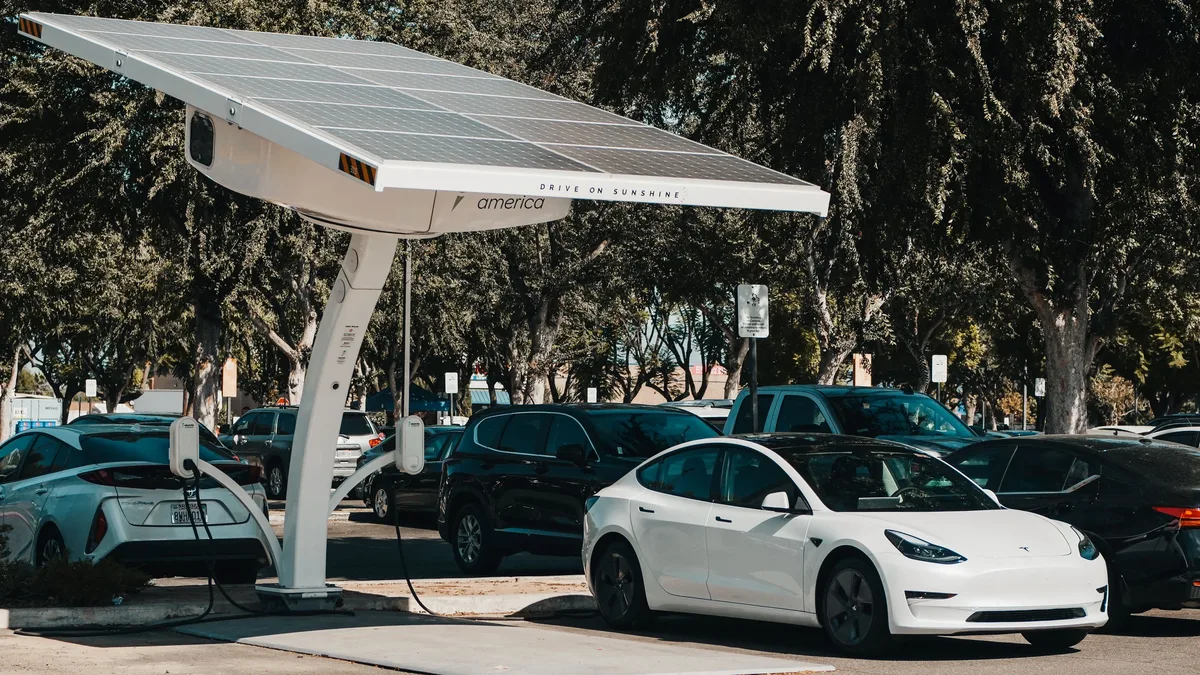
The company also markets another microgrid system called EV-E, designed with integrated EV charging stations. Customers can choose the EV-E4 configuration to charge up to four EVs at a time, or charge up to 7 EVs with the EV-E7 configuration.
Additional options are available for fleets, too. Translucent offers a fully customized microgrid and EV charging system for fleets. Depending on the customer, the entire system can be operated off-grid, or it can operate with a grid connection.
The EV-E BASE rounds out Translucent's charging portfolio. The BASE system accommodates developers who have already selected their own EV charging stations and are expanding into areas where a solar-enabled microgrid can overcome grid bottlenecks. The system can operate fully off-grid, or it can support grid connections that take advantage of lower off-peak electricity costs.
Photo: The solar-enabled microgrid specialist Translucent Energy has just added a new 1.3-gigawatt solar factory to its portfolio, with plans for further expansion already under way (cropped, courtesy of Translucent Energy).
Source: CleanTechnica