
Toyota
| Model | Toyota bZ4X |
|---|---|
| Vehicle type | Battery electric SUV |
| Drivetrain | Front-wheel drive or all-wheel drive |
| DC fast charging standard | Combined Charging System (CCS) |
| Approximate EPA range | 252 to 242 miles (varies by drivetrain) |
| Battery warranty | 8 years or 100,000 miles |
| Original use | Personal transportation |
Origin and history
Toyota Motor Corporation originates from Japan, founded in the late 1930s. The company's origins are in automatic loom manufacturing before it diversified into automobile production. Its first passenger car prototypes were developed in the mid-1930s, with full-scale production commencing in the following decade. Toyota established itself as a dominant global manufacturer throughout the latter half of the 20th century, renowned for production system efficiencies. The company's initial foray into electrified vehicles came with the Prius hybrid, launched in Japan in the late 1990s. Its development of dedicated battery electric vehicles (BEVs) for global markets gained significant momentum in the late 2010s and early 2020s.
What it is designed for
Toyota's electric vehicle models are designed primarily for daily commuting and urban or suburban family transportation. They prioritize reliability, predictable performance, and seamless integration of technology familiar from the brand's hybrid vehicles. The design philosophy emphasizes practicality, user-friendly interfaces, and maximizing real-world efficiency over extreme performance metrics. These vehicles are engineered to serve as accessible entry points into full electrification for the brand's existing customer base. A core design consideration is compatibility with widely available public charging infrastructure, rather than exclusive networks. The vehicles aim to deliver a smooth, quiet driving experience with a focus on cabin comfort and ample cargo utility.
Development and versions
Toyota's BEV development accelerated with the introduction of the e-TNGA dedicated electric vehicle platform in the early 2020s. The first global model on this architecture was the bZ4X SUV, developed in partnership with Subaru, which launched in 2022. Subsequent models include the bZ3 sedan, developed specifically for the Chinese market in collaboration with BYD. The company has also released battery electric versions of its popular Proace and Proace Van commercial vehicles in European markets. Toyota's development strategy often involves strategic partnerships for specific components, such as batteries and powertrains. The company plans a broader lineup of BEVs under the "bZ" (Beyond Zero) sub-brand, with concepts previewing various segments from crossovers to pickup trucks.
Toyota range
The real-world driving range of Toyota's electric models varies significantly by model, trim, and driving conditions, as is industry standard. The range is achieved through careful management of battery thermal systems and aerodynamic vehicle design. Toyota's approach generally favors a conservative and reliable battery management strategy over maximizing headline range figures. All models include regenerative braking systems that can help recapture energy and marginally extend range in stop-and-go traffic. The usable range is directly impacted by climate control use, high-speed driving, and ambient temperature, consistent with all battery electric vehicles.
Toyota interior
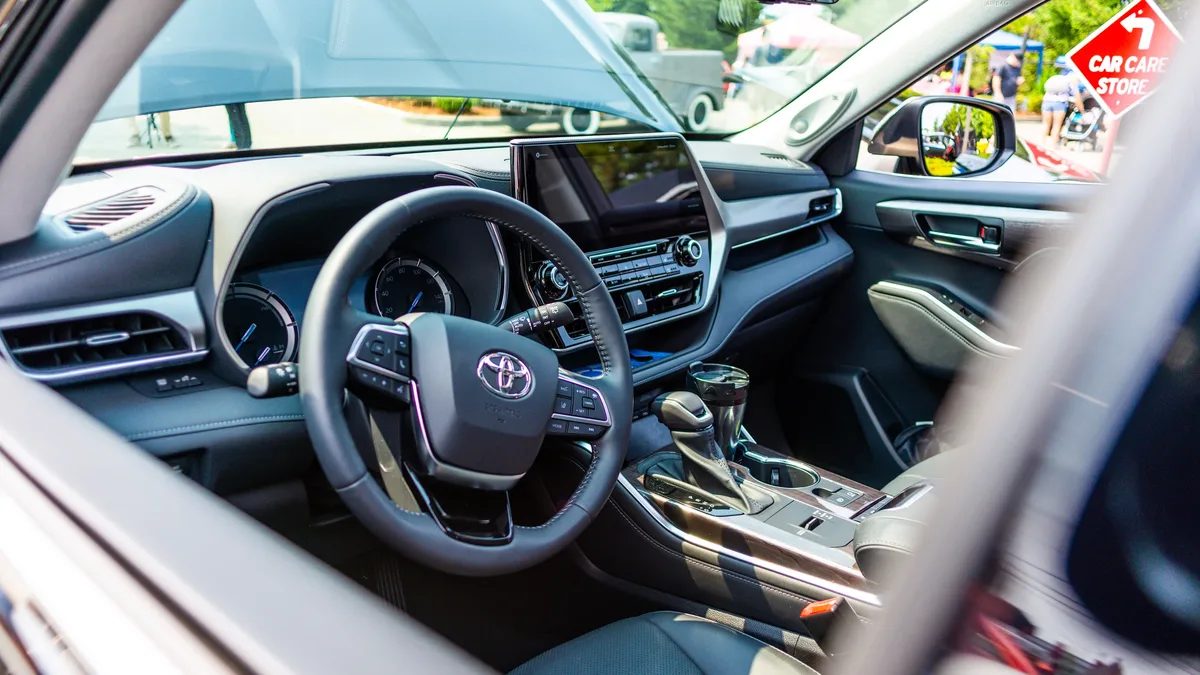
Toyota EV interiors focus on functional design, durable materials, and a raised seating position for commanding visibility. The centerpiece is often a large, centrally mounted touchscreen infotainment system that controls climate and vehicle settings. Cabin space is prioritized, particularly rear legroom and flat floors enabled by the dedicated electric vehicle platform. Material choices tend toward practical, easy-to-clean surfaces with selective use of soft-touch materials on key contact points. Instrumentation is typically digital, though some models feature a unique yoke-style steering wheel or a conventional steering column. Storage solutions include a front trunk (frunk) on some models, deep center consoles, and competitive cargo space in the rear.
Toyota lease
Leasing a Toyota electric vehicle can be a common method of acquisition, mitigating concerns about long-term battery technology evolution. Lease terms are structured by Toyota Financial Services and affiliated institutions, with varying mileage allowances and contract lengths. A key aspect of leasing is the guaranteed future residual value, which is estimated at the contract's inception. These residual values for early Toyota BEVs have been subject to market fluctuations common to new EV model entries. Lessees typically remain responsible for maintaining the vehicle according to the manufacturer's schedule and for any damage beyond normal wear and tear. At lease end, the lessee can return the vehicle, purchase it for the predetermined residual value, or lease a new model.
Pros and cons
A significant pro is Toyota's reputation for build quality and reliability, which extends to the solid construction and dependable battery management in its EVs. The vehicles offer a comfortable, quiet ride with intuitive controls for drivers familiar with the brand's hybrid systems. A common con is that charging speeds, particularly DC fast charging, can be conservative compared to some competitors, leading to longer stop times on road trips. The common mistake is not verifying real-world range in one's specific climate, as cold weather can significantly reduce the effective distance between charges. Another drawback can be the initial limited model variety, offering fewer choices than some legacy automakers in the EV space.
Who it suits
This vehicle suits pragmatic buyers seeking a dependable, no-fuss electric car from a familiar brand with an extensive dealer network. It is ideal for households needing a comfortable, spacious electric SUV for daily errands and commuting within its effective range. The Toyota EV is a strong match for current Toyota hybrid owners looking to transition to a full battery electric vehicle with minimal operational learning curve. It suits drivers who primarily charge at home overnight and use public charging networks occasionally, rather than those who rely exclusively on frequent long-distance rapid charging. The vehicle is less suited for technology enthusiasts seeking the fastest charging speeds, the most aggressive performance, or the most avant-garde interior design. It is a rational choice for those who prioritize proven manufacturing quality and predictable ownership costs over being an early adopter of the latest EV performance benchmarks.
Latest Toyota news
Latest reporting
Toyota's $14,000 bZ3X EV spotted testing in right-hand drive
Toyota's best-selling Chinese electric SUV, the bZ3X, has been seen testing overseas in a right-hand-drive configuration.
Toyota's electric SUV sales surge to nearly 5,000 in August
Toyota led U.S. EV sales growth in August, selling 4,964 units, a 35% increase from July. The automaker's updated bZ SUV, now with a built-in NACS...
Toyota's Guardrail ADAS in 2028 Models
Toyota plans to launch a new advanced driver assistance system in 2028, aiming for capabilities between Level 2 and Level 3 autonomy.
Nissan Rogue e:Power Hybrid SUV Launches in
Nissan will launch its Rogue e:Power hybrid SUV in the U.S. In November, aiming to compete with the Toyota RAV4 and Honda CR-V Hybrid.

2027 Toyota bZ Now on Sale, Starting at $34,980 in the US and CA$45,985 in Canada
The 2027 Toyota bZ is now available for purchase, with prices starting at $34,980 in the US and CA$45,985 in Canada. The electric SUV features...